
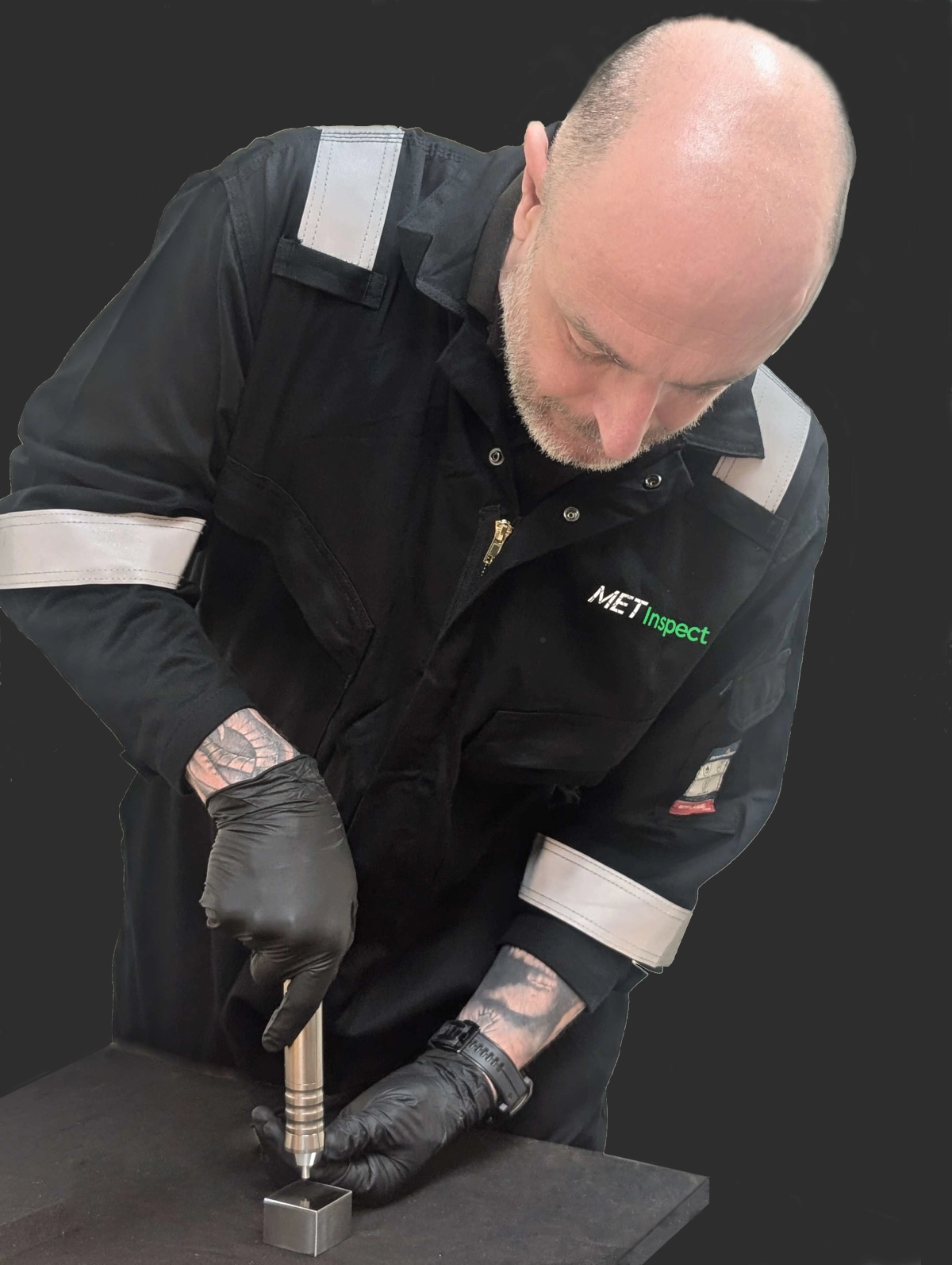
The Ultrasonic Contact Impedance (UCI) Method: Precision On-Site Hardness Assessment
In preparing for critical on-site material assessments, we frequently employ the Ultrasonic Contact Impedance (UCI) method, a specialised technique for portable hardness testing. This advanced procedure allows for accurate material verification without requiring the removal of large samples, which proves invaluable in field operations.
Understanding the Methodology
The UCI probe, equipped with a Vickers diamond indenter , is excited into a longitudinal ultrasonic oscillation. When the indenter is pressed against the test surface with a fixed force, the resonant frequency shifts in proportion to the size of the indentation area.
The Key Advantages for Our Clients
For clients requiring reliable and efficient material verification, the UCI method offers substantial practical advantages over static and dynamic alternatives:
Exceptional Portability and Access: This is particularly valuable for measuring positions that are difficult to access,
Assessment of Critical Zones: The small indentation size is ideally suited for assessing the narrow, critical Heat-Affected Zone (HAZ) of a weld,
Suitability for Thin Layers: It is suitable for testing thin surface-hardened layers or coatings (e.g. nitrided or chrome layers) that must typically be greater than ten times the Vickers penetration depth.
Efficiency and Reliability: The electronic measurement process ensures highly reproducible results and makes testing quicker and simpler than traditional, low-load Vickers methods . Moreover, the method typically requiring a minimum wall thickness of only 2 to 3 mm