
Microstructural Replication
In-Situ Metallography: Evidence for Life Assessment
Microstructure replication, technically known as in-situ metallography, is a highly versatile, non-destructive technique that allows for the examination of a component's microstructure directly in its service location.
Uses & Benefits of Replication
This method is considered critical for accurately assessing the integrity and health of equipment, particularly those exposed to high temperatures and pressures within power plant and related facilities. The process involves meticulous surface preparation by grinding and polishing, followed by etching to reveal the microstructure. A film is then applied to create a relief replica, which is subsequently examined under a microscope. This analysis is crucial for detecting, assessing, and monitoring damage, providing valuable insights for component life assessment and helping prioritize maintenance and repair decisions to ensure safe and cost-effective operation. While particularly useful for detecting early-stage damage such as creep cavities, its effectiveness is typically limited to the surface or near-surface layers.

Surface preparation, grinding, for replication
A video taken by one of our experts, showing a weld and its heat affected zone as they are revealed by etching.
Integrity Assessment and Life Cycle Management
Condition Monitoring and Life Assessment: Replication is critical for monitoring in-service degradation and assessing the creep damage state of critical components. This data is essential for evaluating material status and allowable service extension, contributing to residual service life analysis.
Prioritisation of Inspections: Understanding damage mechanisms through microstructural assessment allows us to help clients prioritise inspection locations based on comprehensive risk analysis.
Cost-Effectiveness: The technique supports monitoring and maintenance programmes that facilitate the utilisation of the full life of components, potentially beyond their original design life, leading to demonstrable cost savings compared to destructive testing.
Evidence Collection: Replication provides a precise means of collecting microstructural evidence for use in warranty disputes or comprehensive failure analysis before a component is returned or repaired.
Diagnostic Precision & Data
Microstructural Evidence: The analysis records subtle evidence of manufacturing processes (including welding) and operational damage or abuse, such as fatigue, process upsets, high-temperature corrosion and creep.
Quantitative and Qualitative Assessment: For certain damage types like creep, replication allows for both quantitative (e.g., cavities per mm²) and qualitative assessments, providing definitive, actionable data.
Early Damage Detection: The method is particularly useful for detecting and characterizing the onset of early-stage damage, such as creep cavities and fatigue, enabling preemptive corrective actions.
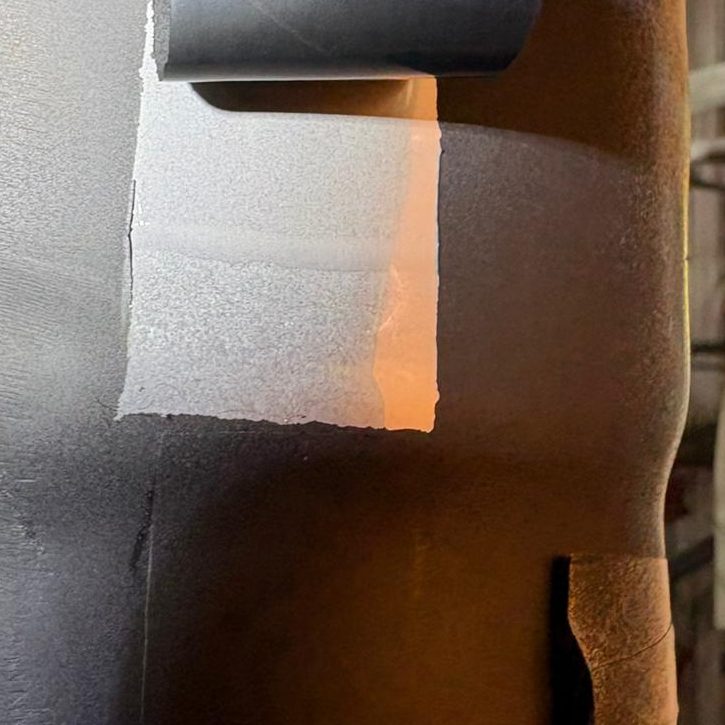
A replica being removed and revealing the replicated weld , heat affected zone and parent material