
An Introduction to Corrosion Mechanisms and Material Susceptibility
Introduction: The Pervasive Challenge of Material Degradation
Corrosion is a natural, and often relentless, process of material degradation that occurs when a metal reacts with its environment. At its core, it is an electrochemical phenomenon where the metal deteriorates through oxidation, attempting to revert to a more chemically stable form, such as an oxide or sulfide. This seemingly simple process carries profound economic and safety implications across nearly every industry, from infrastructure and transportation to manufacturing and energy production.
The purpose of this article is to provide a foundational, yet technically accurate, overview of common corrosion forms, the factors that influence them, and the relative susceptibility of key engineering materials. It must be stated that corrosion science is an immensely broad and interdisciplinary subject; this article provides a framework but is by no means exhaustive.
The Electrochemical Fundamentals of Corrosion
For corrosion to occur, three fundamental components must be present: an anode, where the metal is oxidized (corrodes); a cathode, where a reduction reaction consumes the electrons released at the anode; and an electrolyte, an electrically conductive medium (such as water, soil, or a chemical solution) that allows for the flow of ions. Together, these three components form a corrosion cell, the basic unit of electrochemical degradation.
A critical distinction to make is between the tendency for corrosion to occur, which is governed by thermodynamics, and the actual rate at which it proceeds, which is a matter of kinetics. A metal may have a strong thermodynamic tendency to corrode, but if the kinetic rate is sufficiently slow, it can still provide excellent long-term service.
Corrosion Thermodynamics
Thermodynamics helps predict whether corrosion is possible under a given set of conditions. Tools such as Pourbaix (E-pH) diagrams are invaluable for this purpose. These diagrams map the thermodynamic stability of a metal in contact with water across a range of electrochemical potentials (E) and pH values. For a given combination of potential and pH, a Pourbaix diagram can indicate whether the metal is expected to be immune (stable), to corrode (form soluble ions), or to passivate (form a stable, protective solid film like an oxide).
Corrosion Kinetics
While thermodynamics indicates the tendency to corrode, corrosion kinetics determines the rate of the reaction. Kinetic factors are the reason why some thermodynamically reactive metals perform exceptionally well in practice. For instance, aluminum has a very strong thermodynamic driving force to corrode in air and water, but it instantly forms a thin, dense, and highly adherent passive oxide film on its surface. This film acts as a barrier that dramatically slows the kinetic rate of further corrosion, providing excellent protection in many environments.
Recognizing the Common Forms of Corrosion
Corrosion is not a single, uniform phenomenon but rather a collection of distinct degradation mechanisms. Identifying the specific form of corrosion is the critical first step in performing a failure analysis and implementing an effective prevention strategy.
Localized Corrosion: Pitting and Crevice Attack
Localized corrosion is particularly insidious because it can lead to component failure with very little overall loss of metal.
- Pitting Corrosion: This is a localized form of attack, common in passive alloys like stainless steel and aluminum, that occurs when the protective passive film is locally broken down by aggressive anions, most commonly chlorides. This results in the creation of small holes, or "pits," on the metal surface. This form of attack is dangerous because it can lead to perforation and catastrophic failure with only a negligible loss of total material mass.
- Crevice Corrosion: This is a localized attack that occurs within confined spaces where a stagnant solution can exist, such as areas under gaskets, washers, and bolt heads. The process initiates due to a differential aeration cell, where oxygen within the crevice is consumed and cannot be replenished, leading to an aggressive local chemistry change.
Galvanic Corrosion
Galvanic corrosion is an accelerated attack that occurs when two different metals are in direct electrical contact while immersed in a conductive electrolyte. One metal acts as the anode and corrodes at an accelerated rate, while the other acts as the cathode and is protected. The tendency for this can be predicted using a Galvanic Series.
A related mechanism is Deposition Corrosion, where ions of a more noble metal plate out onto the surface of a more active metal, creating small local cathodes that drive localized pitting.
Metallurgically Influenced Corrosion
These forms are directly linked to the alloy's microstructure, composition, or processing history.
- Intergranular Corrosion: This is a preferential attack along the grain boundaries. A classic example is the sensitization of austenitic stainless steels, where chromium carbides precipitate at grain boundaries, depleting the adjacent regions of chromium and making them susceptible to corrosion.
- Selective Leaching: This involves the preferential removal of one element from a solid alloy. Examples include Dezincification in brass (removing zinc) and Graphitic Corrosion in gray cast iron (corroding the iron matrix and leaving a weak graphite network).
Mechanically Assisted Corrosion
These involve a synergistic interaction between a mechanical action and a corrosive environment.
- Erosion-Corrosion: The acceleration of damage caused by the combined action of a corrosive fluid and mechanical wearing from its flow. The fluid motion strips away protective passive films, continuously exposing fresh metal.
- Cavitation: Severe damage resulting from the collapse of vapor bubbles near a metal surface. The resulting localized shock waves mechanically blast away protective films and underlying metal, appearing as sharp-edged pits.
Environmentally-Induced Cracking
Stress Corrosion Cracking (SCC) is a form of failure caused by the simultaneous action of a sustained tensile stress and a specific corrosive environment. For a given alloy, SCC will only occur in the presence of certain chemical species; for example, austenitic stainless steels are susceptible to SCC in chloride-containing environments, and carbon steels are susceptible in certain caustic or nitrate solutions. SCC is a time-dependent process, and many alloys exhibit a threshold stress below which cracking will not occur. This threshold can be a specific value, such as a minimum stress level or, in fracture mechanics terms, a threshold stress intensity factor (KthSCC) below which cracks will not propagate. The resulting cracks can propagate either between the grains (intergranular) or through them (transgranular).
Microbiologically Influenced Corrosion (MIC)
MIC refers to corrosion initiated or accelerated by the metabolic activity of microorganisms. A common culprit is sulfate-reducing bacteria (SRB), which produce aggressive hydrogen sulfide that leads to severe corrosion of steel in anaerobic environments.
The Role of the Environment
A material's corrosion performance is inextricably linked to its service environment.
- Aqueous Environments: Key factors include pH (acidity/alkalinity), dissolved gases (like oxygen), dissolved solids (particularly chlorides), and temperature & flow.
- Atmospheric Environments: The most important factor is moisture (relative humidity and dew point), alongside airborne pollutants like sulfur compounds (SO₂), and chlorides (sea salt or deicing salts).
- Soil Environments: Corrosivity depends on resistivity, moisture content & aeration, pH, and the presence of microbes like SRB.
Material Susceptibility: A Comparative Overview
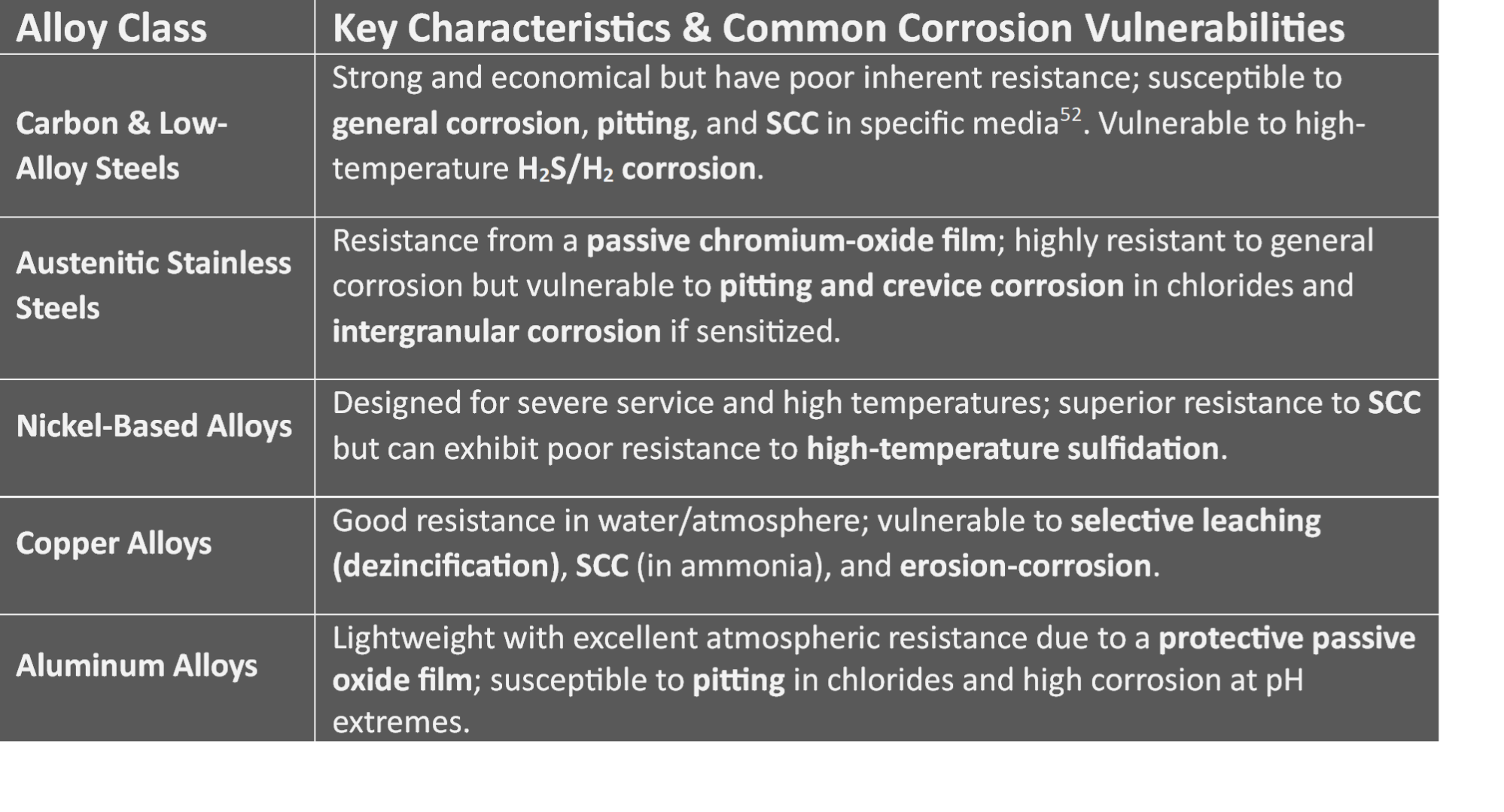
Strategic material selection is one of the primary pillars of effective corrosion control. While no single material is immune to degradation in all environments, understanding the inherent characteristics and common corrosion vulnerabilities of major alloy families is crucial for reliable and safe design. The following table provides a comparative overview, summarizing the key vulnerabilities a designer must consider for each major alloy class.
Fundamental Principles of Corrosion Control
Mitigating corrosion is not a reactive task but a proactive, multi-faceted engineering discipline. The goal is to manage the interaction between the material and its environment to prevent degradation and extend the service life of an asset. The primary strategies employed by engineers are based on interrupting the electrochemical corrosion cell.
- Materials Selection and Design: This is the first line of defense. Fundamental design rules for corrosion prevention include selecting the most appropriate and economical material for the specific service environment and designing components to eliminate crevices, ensure complete drainage of vessels and piping, and prevent dissimilar metal contact.
- Protective Coatings: This strategy involves applying a barrier layer to physically isolate the metal surface from its corrosive environment. This is one of the most common methods of corrosion control and includes organic coatings (paints), metallic coatings (such as galvanizing steel with zinc), and inorganic coatings.
- Cathodic Protection (CP): This electrochemical technique protects a structure by making it the cathode of the corrosion cell. This is achieved by connecting the structure to either a more easily corroded "sacrificial anode" (like zinc or aluminum) or by using an external DC power source to impress a current onto the structure (ICCP). CP is widely used to protect buried pipelines, ship hulls, and offshore platforms.
- Anodic Protection: A less common but effective technique for specific metal-environment systems, anodic protection uses an external current to maintain a metal within its passive region, where corrosion rates are extremely low. It is primarily used to protect steels and stainless steels in highly aggressive acidic environments.
- Corrosion Inhibitors: These are chemical substances that, when added in small concentrations to an environment, effectively decrease the corrosion rate of a metal. Inhibitors are widely used in closed-loop cooling systems, oil and gas production, and chemical processing to protect equipment from internal corrosion.
Conclusion
Corrosion is a complex electrochemical phenomenon with far-reaching economic and safety consequences that command serious engineering attention. The degradation of metallic structures is not random but is governed by the fundamental laws of thermodynamics and kinetics. Preventing costly and potentially catastrophic failures requires a holistic understanding of the intricate interactions between the material of construction, the specifics of its service environment, and the influence of any applied or residual mechanical stresses.
By recognizing the different forms of corrosion—ranging from uniform attack to localized pitting and stress-assisted cracking—engineers can better diagnose failures and design more resilient systems. However, it is crucial to recognize that the prevention and control of corrosion is a specialized and dynamic field that demands a rigorous, interdisciplinary approach to ensure the long-term integrity and safety