
Post-Fire Structural Steel Integrity Assessment
Fire-Exposed Steel: Evidence for Safe Reuse
When structural steel assets have been exposed to fire, the paramount question for owners and engineers is the residual safety and fitness-for-purpose. We provide a definitive, evidence-based service to replace conjecture with certainty, enabling confident decisions on reuse or remediation.
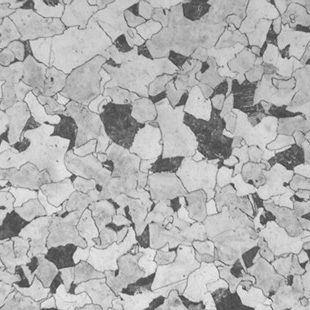
The microstructure that a structural steel would ordinarily be supplied with, normalised ferrite and pearlite
The Scope: Verifying Strength and Confirming Microstructural Resilience
Our post-fire analysis is a meticulous investigation into the mechanical integrity of the steel, focusing on two critical properties:
Tensile Strength : We quantify if the steel has softened due to heat exposure, thereby reducing its ability to carry its design load.
Microstructural Resilience (Resistance to Brittle Failure): We assess whether the steel’s microstructure has been compromised—which can occur because of rapid cooling from elevated temperature—and may have caused a loss of original toughness.
Our Approach: Non-Destructive Site Assessment
In preparing our findings, we utilise advanced, predominantly non-destructive field techniques to achieve clear and unambiguous conclusions:
Hardness Testing: We conduct precise, in-situ hardness testing using calibrated portable equipment. This allows us to accurately convert the measured hardness values into the approximate equivalent Tensile Strength. Crucially, we verify if the steel meets or exceeds the minimum strength requirements for its specified grade (such as S275 or S355). Our work frequently confirms that components retain tensile strength well within, or indeed surpassing, the required parameters.
Microstructure Replication: As a consultancy with competence and extensive experience in metallographic field replication, we take a replica (a high-resolution 'fingerprint') of the steel's microstructure on site. The replica is then analysed under high magnification. This vital step can whether there has been adverse permanent changes to the steel microstructure — such as brittle phase formation or detrimental grain growth hat could jeopardies the steel's resilience. We verify that the components exhibit no marked deviation from expectation for material supplied in the normalised condition.
By combining these verified methods, we deliver the definitive technical evidence required for confident structural certification and project progression.
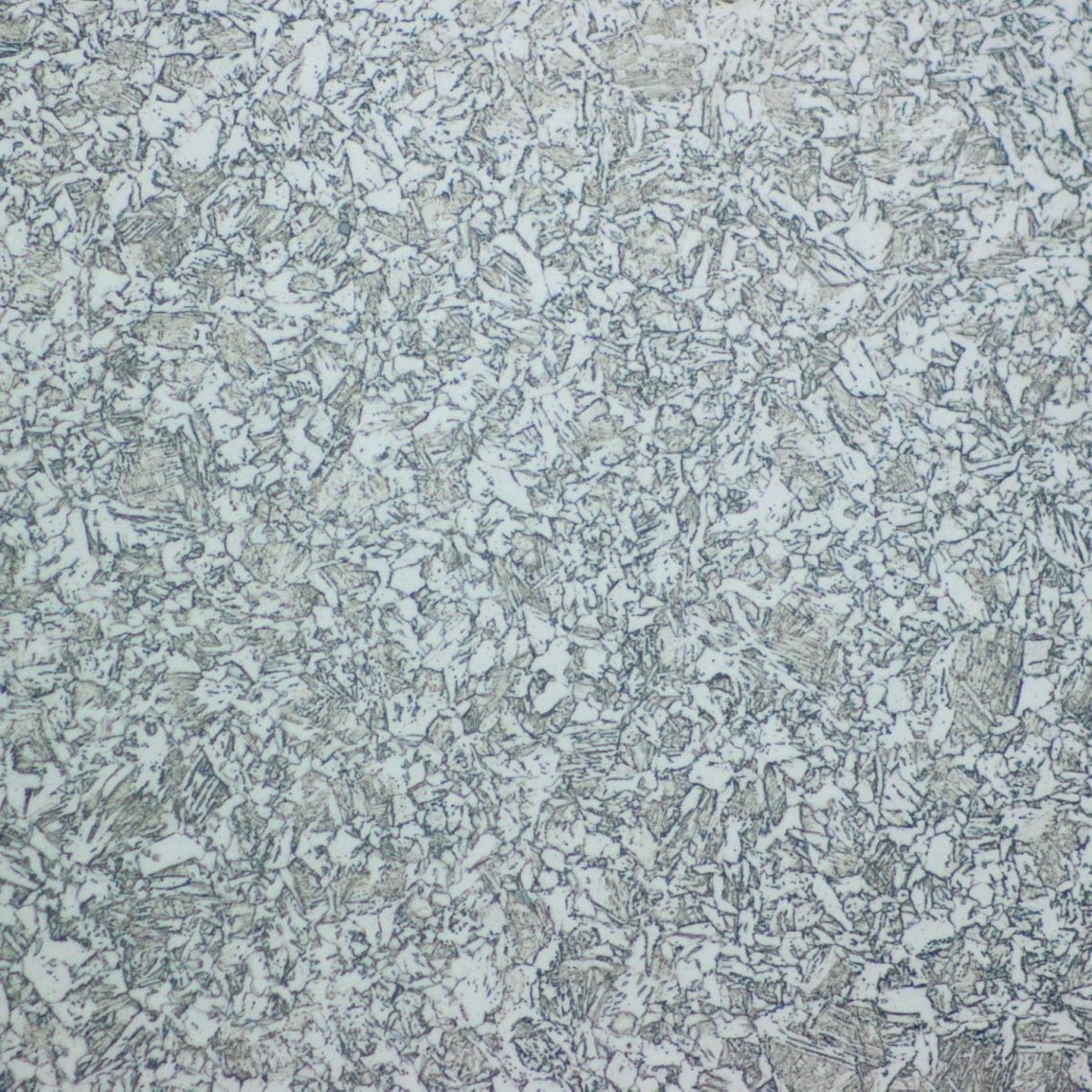
A structural steel that was subjected to temperatures in excess of 900 ºC for 3 hours after which it was quenched in water.