
A Metallurgical Guide to the Post-Fire Assessment of Structural Steel
Introduction: Steel Structures After the Fire
When a steel-framed structure is hit by a fire, it can undergo a massive, uncontrolled, and non-uniform heat treatment that alters its properties and catastrophically compromises its integrity. This presents a critical challenge for everyone tasked with determining the structure’s safety afterward—architects, engineers, and surveyors alike. A misunderstanding of these principles can tragically lead to the failure of a structure that appears merely cosmetically damaged, jeopardizing both property and human life.
This guide provides the essential metallurgical principles needed to understand and evaluate this profound transformation. The scope is to explain the critical phase transformations that steel experiences when heated and cooled, the resulting changes to its internal microstructure, and the direct impact these changes have on key mechanical properties such as strength, ductility, and, most critically, fracture toughness. By understanding these principles, stakeholders can move past superficial visual inspection and apply a sound, evidence-based methodology for post-fire assessment. A foundational understanding of steel's basic metallurgy is the first and most crucial step in a competent and reliable evaluation..
Fundamentals of Structural Steel Metallurgy
To accurately assess a fire-damaged structural steel structure, we must first understand its baseline condition. The remarkable performance of structural steel isn't accidental; it's a direct result of a carefully controlled microstructure—the specific arrangement of its atoms and the phases present at ambient temperatures. These fundamental characteristics are precisely what the thermal chaos of a fire can irrevocably alter.
The Allotropy of Iron
The foundation of steel's versatility lies in a property of elemental iron known as allotropy, meaning it can exist in different crystal structures at different temperatures.
- •At room temperature, iron exists in a Body-Centered Cubic (BCC) crystal structure known as alpha-ferrite (α-ferrite). In this structure, carbon has very limited solubility.
- When heated above 912°C, iron transforms into a Face-Centered Cubic (FCC) structure called austenite (γ-phase). The atomic arrangement of FCC austenite allows it to dissolve significantly more carbon than BCC ferrite.
This ability to change crystal structure and carbon solubility with temperature is the key to all heat treatment of steel, whether controlled in a mill or uncontrolled in a building fire.
The Iron-Iron Carbide (Fe-Fe₃C) Phase Diagram
The Iron-Iron Carbide (Fe-Fe₃C) phase diagram is truly the essential roadmap for understanding the relationship between temperature, carbon content, and the stable phases present in steel. For the low-carbon steels used routinely in construction, the following phases and microconstituents are of primary importance:
- α-Ferrite: The soft, ductile BCC solid solution of carbon in iron that exists at room temperature.
- Cementite (Fe₃C): A very hard and brittle intermetallic compound of iron and carbon.
- Pearlite isn't a single phase; it's a microconstituent composed of alternating layers (lamellae) of softα-ferrite and hard cementite (Fe₃C). It forms when austenite is cooled slowly through the eutectoid temperature of 727 °C. This layered structure functions like a microscopic composite, where the hard cementite acts as reinforcement within the soft, ductile ferrite matrix. This unique arrangement gives the steel its characteristic balance of strength and toughness
Typical Pre-Fire Microstructure
A typical low-carbon structural steel (containing less than 0.25 % carbon by weight) has a microstructure consisting of proeutectoid ferrite and pearlite . This combination provides the essential balance of strength and ductility that makes it ideal for construction: the ferrite imparts toughness and ductility, while the pearlite contributes strength and hardness. However, this stable, predictable, and reliable microstructure can be profoundly and irrevocably disrupted by the extreme thermal cycle of a building fire.
The Fire as an Uncontrolled Heat Treatment
From a metallurgical perspective, a building fire is nothing less than an uncontrolled heat treatment process. Both the peak temperatures reached and the subsequent cooling rates are highly variable throughout the structure, depending on factors like fuel load, ventilation, and the use of fire suppression systems. Critically, these two variables—peak temperature and cooling rate—are precisely what dictate the steel's final, post-fire metallurgical condition and, ultimately, its mechanical properties.
The Heating Cycle: Transformation to Austenite
As structural steel is heated during a fire, its temperature rises above the eutectoid point of 727 °C. At this critical stage, the original microstructure of ferrite and pearlite begins to transform into the single, high-temperature phase: austenite. The extent of this transformation, and its consequences, depend on both the peak temperature reached and the duration of exposure. If the steel is held at a high temperature for a prolonged period, the austenite grains will begin to grow. This grain growth is a critical phenomenon , as an excessively coarse grain structure can lead to a significant reduction in the steel's toughness after it cools.
The Cooling Cycle: Formation of New Microstructures
The most critical part of the fire's thermal cycle (assuming the heating cycle exceeded the eutectoid temperature) is the cooling phase. The final microstructure of the steel is entirely dependent on the rate at which it cools from the austenitic state—a relationship graphically represented by Continuous-Cooling-Transformation (CCT) diagrams . The outcomes can be understood by considering three primary cooling paths on such a diagram:
- Slow Cooling: If a fire simply burns out and the steel cools slowly in the ambient air, the transformation is diffusion-controlled. The austenite transforms back into a mixture of ferrite and coarse pearlite. This is analogous to an annealing heat treatment, typically resulting in a softer, weaker, but more ductile material compared to its original state.
- Moderate Cooling: A moderate cooling rate results in the formation of fine pearlite. The thinner lamellae of ferrite and cementite in fine pearlite make it harder and stronger than coarse pearlite, but with reduced ductility.
- Rapid Cooling (Quenching): This is the most critical and potentially dangerous scenario. If hot, austenitic steel is rapidly cooled—for example, by the application of fire-fighting water—the normal transformation is suppressed. Instead, the austenite undergoes a diffusionless transformation, resulting in martensite. Martensite is extremely hard, strong, and, most importantly, very brittle.
These new, fire-induced microstructures could possess dramatically different mechanical properties from the original steel—a factor that is paramount to assessing the future safety of the structure.
Post-Fire Mechanical Properties of Structural Steel
The changes in microstructure directly translate to significant, and often detrimental, changes in the steel's mechanical performance. A competent post-fire assessment must quantify these changes to determine if the structure remains safe for continued service or requires remediation.
Strength and Hardness
The various microstructures that can form upon cooling possess a wide, critical range of strength and hardness properties . At one extreme, Martensite is the hardest and strongest. At the other, Spheroidite (a structure formed by extensive annealing where cementite forms as small spheres) is the softest and most ductile. The following table provides a relative comparison of the mechanical properties of potential post-fire microstructures:
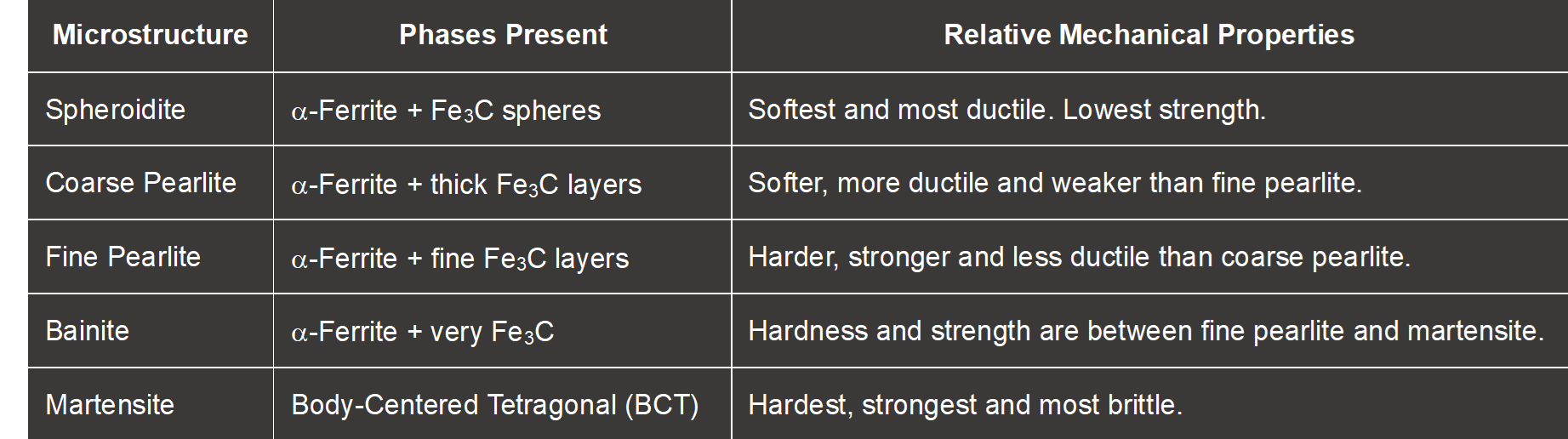
Because of the strong, direct correlation between hardness and tensile strength, on-site hardness measurements (e.g. UCI - Hv) provide a rapid and effective non-destructive method for inferring changes in strength. A comprehensive hardness map is therefore absolutely essential to quickly identify areas of dangerous hardening (potential martensite formation) or excessive softening (over-annealing).
Ductility, Toughness, and Brittle Fracture Risk
The most critical—and often hidden—consequence of fire damage is a loss of fracture toughness and a corresponding increase in the risk of brittle fracture. This is directly related to a property known as the Ductile-to-Brittle Transition Temperature (DBTT).
Steel, like other BCC metals, exhibits a transition in its fracture behavior with temperature . Above the DBTT, steel fails in a ductile manner, absorbing significant energy and showing visible deformation. Below the DBTT, it fails in a brittle manner with very little energy absorption, often catastrophically and without warning.
The thermal cycle of a fire can dangerously alter a steel's DBTT. The formation of brittle martensite or severe grain coarsening can significantly increase the DBTT. This creates a treacherous hidden vulnerability: a steel beam that was perfectly ductile and safe in the summer could, after a fire, have its DBTT raised above 0 °C.
Principles of a Methodical Post-Fire Assessment
A reliable assessment of fire-damaged steel cannot be based on visual appearance alone; distortions and discoloration are simply not definitive indicators of the underlying metallurgical condition. A sound assessment requires a systematic, multi-phase investigation. The process begins with on-site evaluation to map potential damage, followed by targeted in situ analysis or material sampling, combined with laboratory analysis to quantify the steel's remaining service capability.
On-Site Inspection and Non-Destructive Testing (NDT)
The assessment begins on-site with a thorough visual inspection and targeted Non-Destructive Testing (NDT).
- Visual Inspection: This is used to identify gross deformations such as sagging beams or buckled columns. Such distortions are clear indicators that the steel reached temperatures high enough to cause significant strength loss and may have experienced creep, which is time-dependent deformation at elevated temperatures.
- Portable Hardness Testing: A systematic hardness survey is the primary NDT method . By taking numerous hardness readings across affected structural members, we can create a map of the material's properties. This map will identify localized zones of significant hardening (indicating martensite formation from quenching) or softening (indicating annealing from slow cooling), which guides the selection of the most critical locations for metallographic examination.
- Metallographic Examination: This involves polishing and etching the sample to reveal its microstructure under a microscope. To do this, we employ in situ metallographic replication to take a high-resolution, non-destructive fingerprint of the steel’s microstructure in situ. This is the only way to definitively identify the phases present (e.g., coarse pearlite, fine pearlite, bainite, or martensite) and assess features like grain size.
Destructive Testing
There may be circumstances in which destructive testing is used to supplement Non-Destructive Testing (NDT). This requires physical material samples (cores or coupons) to be extracted from areas identified during the NDT survey as having the highest hardness (potential martensite) or lowest hardness (potential over-annealing). These samples are then subjected to a series of laboratory tests:
- Tensile Testing: A tensile test is performed by pulling a precisely machined sample to fracture. This provides quantitative data on the material's post-fire properties, including its yield strength, ultimate tensile strength (UTS), and ductility (% Elongation). These measured values can be compared directly to the original material specifications to determine the precise extent of degradation.
- Impact Toughness Testing: The Charpy V-notch impact test is used to determine the energy a material absorbs during fracture. By conducting these tests at a range of temperatures, the post-fire Ductile-to-Brittle Transition Temperature (DBTT) can be precisely determined. This test may be crucial for assessing the risk of brittle fracture.
Conclusion: From Assessment to Action
A fire imposes a complex and uncontrolled heat treatment on structural steel, fundamentally altering its internal structure and mechanical behavior. The key to a successful post-fire assessment lies in a thorough understanding of the link between the highly variable cooling rates, the resulting microstructures that form, and their profound effects on mechanical properties. The transformation of ductile ferrite-pearlite into brittle martensite, in particular, represents a critical degradation that elevates the risk of catastrophic brittle fracture.
A methodical metallurgical assessment, centred primarily on in-situ non-destructive testing (NDT), empowers architects, engineers, and surveyors to move beyond simple visual inspection. The NDT-based data often provides the complete answers needed, with targeted laboratory analysis strategically reserved for conclusive verification in complex or ambiguous cases. This approach provides the quantitative data needed to make sound, evidence-based decisions regarding the repair, strengthening, or replacement of fire-damaged steel components. This rigorous approach provides the only reliable basis for ensuring the long-term safety and integrity of the rehabilitated structure.